Why Your #1 SEO Ranking Dropped After “Improving” the Page

7 Things I Wish I Knew Before About Scaling SEO for Large Websites
As a proactive person, it’s natural to want to improve things constantly.
More optimisation. More content. More changes.
However, in SEO, more activity does not always lead to better results.
In fact, some of the biggest ranking drops happen immediately after a page is “improved”. It’s a pattern many businesses experience the hard way.
In this article, we explain why this happens, how to prevent self-inflicted drops, and how to recover when they occur.
It’s also important to recognise that not all ranking drops are self-inflicted. Search engine algorithm updates or competitors improving their websites can also impact performance, which makes having a stable baseline even more critical when diagnosing issues.
If your SEO performance feels inconsistent despite ongoing effort, the issue may not be execution, but a lack of structure.
A clear operating model often unlocks more growth than simply doing more optimisation.
What This Doesn’t Mean
The approach described in this article may sound somewhat controversial, so it’s important to clarify:
- It does not mean “don’t optimise”
- It does not mean “never update content”
- It does not mean “ignore competitors”
Instead, it means:
Optimise with a clear understanding of what you want to achieve in each specific case, not by default. Test changes in a controlled way, rather than making continuous, untracked updates without purpose. The goal is to build on what already works, rather than create a zero-sum game.
1.SEO Is a System With Dependencies
SEO is not a checklist. It’s a system.
- Technical structure supports content
- Content supports rankings
- Authority reinforces both
- Internal linking connects everything
Each layer is interconnected and depends on the previous one.
When you change one element in isolation, it doesn’t always improve the system. It can also affect the balance in ways that are not immediately visible.
2.Rankings Are Not a Score, They’re a Balance
Many people think rankings work like this:
Add more content → get better rankings”
“Add more keywords → get better rankings”
In reality, Google evaluates a combination of signals:
- Relevance;
- Intent match;
- Content structure;
- User behaviour;
- Authority
- And many others.
When a page ranks #1, it means it has reached an optimal balance, one that currently outperforms its competitors.
Changing headlines, copy, or URL structure can shift that balance in either direction, including the wrong one.
3.The #1 Ranking Paradox
This is one of the most misunderstood concepts in SEO:
The higher you rank, the less you should change.
Why?
Because:
- You’ve already hit the best-performing version (for now)
- Any change introduces risk
- The upside is limited, while the downside is real
Many ranking drops happen not because SEO failed, but because a high-performing page was unnecessarily changed.
For example, is there a real need, beyond CRO, to further optimise a page that already ranks #1? It is already the best-performing version.
It’s also important to consider the wider marketing mix. SEO is just one channel, and improvements elsewhere may have a greater overall business impact, so there is often a trade-off. However, it is usually better to find a solution that improves performance without compromising existing SEO rankings.
In some cases, improving conversion rates can lead to a drop in rankings. This is a trade-off you need to recognise: what is more valuable for the business, maintaining a #1 position or increasing conversions.
4.“More Optimisation” Can Actually Hurt Performance
Common examples:
- Adding more keywords with different intent to a page that already ranks
- Rewriting headings that match search intent perfectly
- Expanding content without improving clarity
- Injecting AI-generated content without context
AI is not the issue, but using it without context, strategy, or validation can lead to inconsistent and unpredictable outcomes.
These actions often:
- Dilute intent
- Reduce clarity
- Confuse search signals
Result: rankings drop, even though the intention was improvement.
5.SEO Is Not Instant, It’s Cumulative
Strong SEO performance is built in layers:
- Technical foundation
- Content alignment
- Authority building
- Refinement
Each layer supports the others.
When earlier layers are adjusted repeatedly, it can make it harder to maintain steady progress and may impact overall performance.
6.Not Every SEO Change Leads to Gains
SEO is not a simple “add more, get more” system.
There are trade-offs:
- More keywords can reduce readability
- More content can dilute intent
- More internal links can weaken structure
- More changes can reduce stability
To avoid unintended negative impact, more is not always better. In SEO, balance matters more than volume.
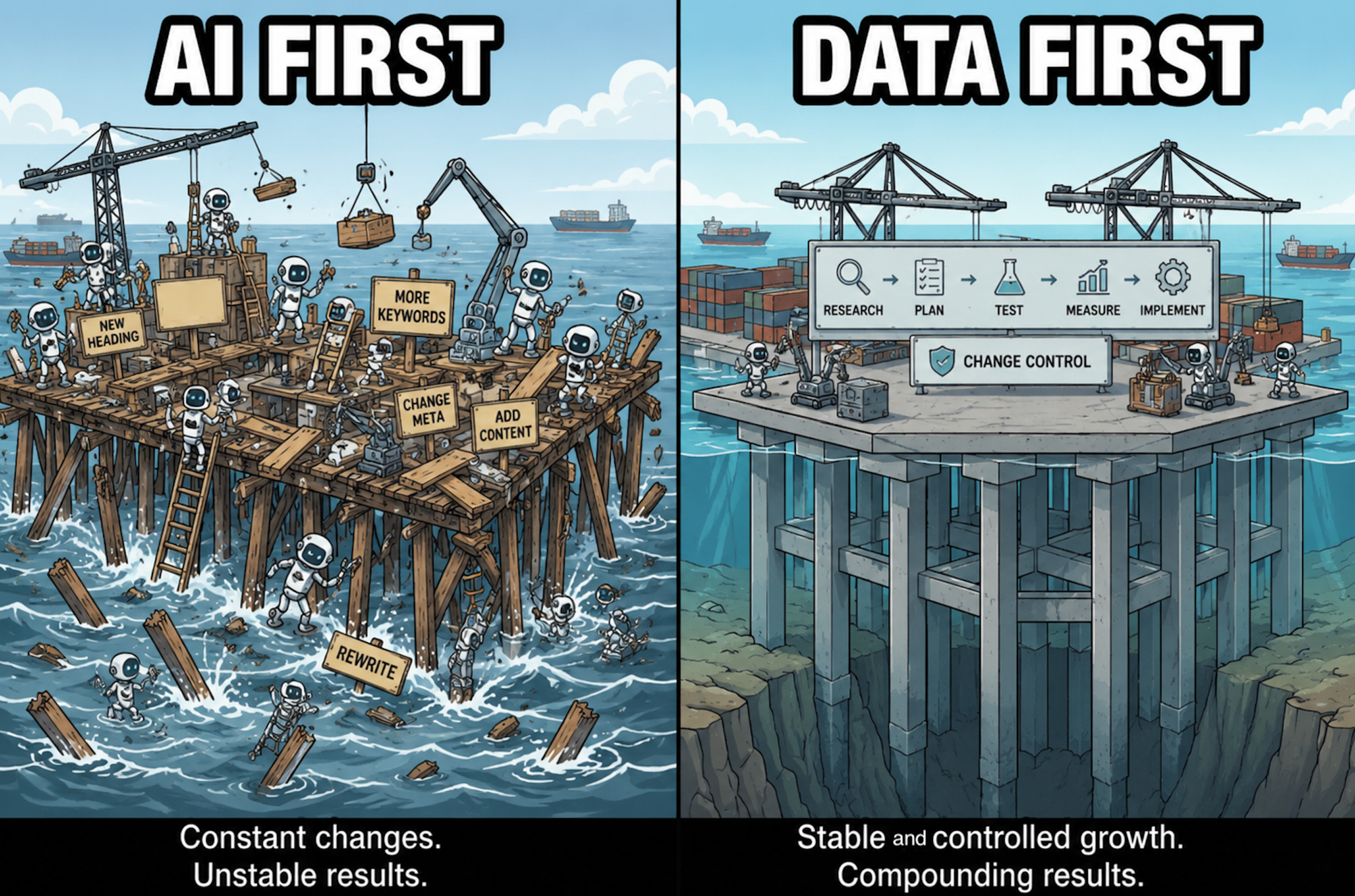
7.High-Performing SEO Requires an Operating Model
Most SEO challenges don’t come from a lack of effort, but from a lack of structure. Without a clear approach, changes become reactive, disconnected, and difficult to manage.
A more effective way forward is to implement a clear SEO Change Control Framework.
SEO Change Control Framework
- Define priority (protected) pages
- Avoid uncontrolled edits on high-ranking pages
- Document and track changes
- Test before rolling out widely
- Align all stakeholders before updates
This is how you move from:
“Constant changes”
to
“Controlled growth”
How to Recover from an SEO Ranking Drop
If your rankings have already dropped, the goal is not to make more changes, but to stabilise the situation first.
Start by:
- Reviewing recent changes
- Identifying what was modified before the drop
- Rolling back or adjusting high-risk changes
- Allowing time for search engines to reprocess the page
In many cases, recovery comes not from doing more, but from undoing what disrupted the balance.
Recovery time can vary from a few days to several months, depending on the scale and complexity of changes and how often search engines re-crawl your website.
SEO Recovery Playbook (Practical Steps)
1.Review Recent Changes
Document everything that changed in the last 6 weeks:
Content edits:
- Title and heading changes
- Copy on the page
- Internal linking updates
- Technical deployments
2. Identify High-Impact Changes
Focus on:
- Pages that were ranking highest
- Changes that could affect search intent (e.g. transactional to informational)
- Structural or URL changes
3. Roll Back Where Necessary
If a page dropped after a specific update, revert to the previous version where possible.
4.Stabilise Before Re-Optimising
Avoid making further changes immediately. Let the page settle and reindex.
5.Monitor Performance Closely
Track:
- Rankings
- Impressions
- Click-through rate
Look for stabilisation before making new decisions. The best way to set up an automated tracker or a dashboard.
6.Reintroduce Improvements Gradually
Once stable, test improvements one at a time, not all at once.
7.Don’t Make the Same Mistake Twice
Document what caused the drop and ensure the same type of change is not repeated. Share these insights with stakeholders across marketing, product, and development teams to prevent similar issues from recurring.
SEO maturity is not just about knowing what to do, but knowing what to avoid.
Controlled Growth Wins
Effective SEO is not about constant change, but controlled progress. When each improvement builds on a solid foundation, growth becomes stable, measurable, and scalable.
Stable growth requires structure. Without a clear framework and the right tools to guide decisions, even well-intentioned changes can produce inconsistent and unpredictable results.
The goal is not to stop improving, but to ensure every improvement moves you forward, not backwards.